Heads Up Poker Small Blind
Byron continues his 'Studying Poker' series with the second in a line of theory-type presentations, on Small Blind Play in Heads-up Sit & Goes. Stay tuned for more top-notch theory from Byron. Showcasing the latest production from ByronJacobs, looking at Sit & Go Small Blind play, observing from the point of view of the short-stack, we see the habits ideally formed to ensure our quality of. The blinds and button in heads up poker is placed as follows; button will always post the small blind, while the other player will post the big blind. Post flop, the big blind will act first, and the person who posted a small blind (button in our case) will remain in the position. Next hand positions of the blinds and the button will switch. For any tournaments and cash games where players are Heads-Up, the small blind will be placed on the button. The button will then be first to act preflop and second to act in all further betting rounds. This rule is widely accepted and explained in the Robert's Rules of Poker, which the vast majority of poker rooms use these days. In heads-up play, the dealer is the small blind and acts first before the flop and last after the flop. The first card is dealt to the non-dealer (the big blind).
When starting heads-up play, deal a single card face-up to each player. The player with the highest card gets the button first. This player posts the small blind, and the other player posts the big blind. Both players post antes into the center of the table if there are any antes.
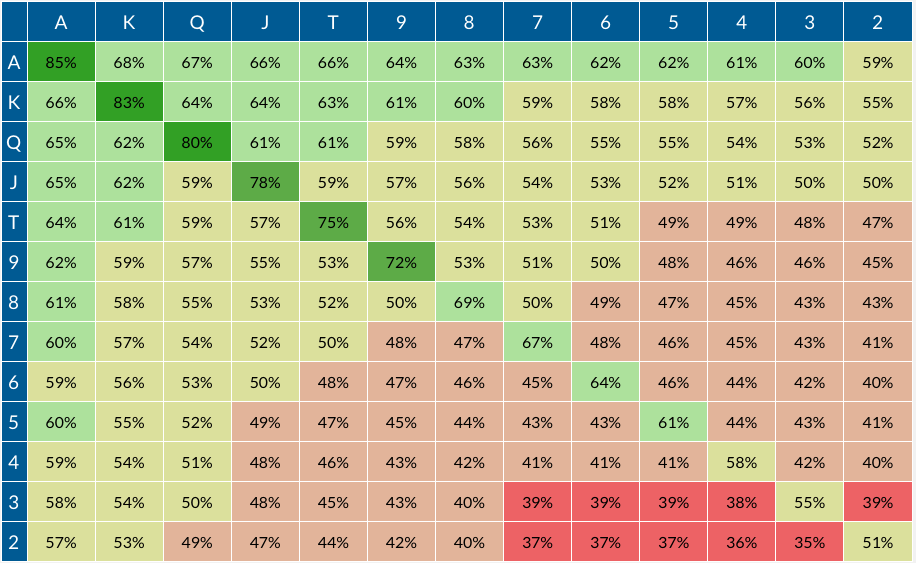
Heads-Up Rules for Texas Hold’em Poker
Heads up Texas Holdem is one of the most fun, challenging and misunderstood variations of holdem. The thrill of playing a friend or foe in a battle of heads up holdem is unmatched in all of poker. Is he bluffing? Does he have the nuts? Should I value bet my second pair? Well, I will not get ahead of myself just yet. Before you can play Texas Holdem heads up against an opponent, you have to know the rules, right?
Best Poker Sites for Heads-Up Texas Hold’em
| Logo | Visit Site | Rating | Bonus | Code | Poker Room Review |
|---|---|---|---|---|---|
| 888 Poker | 98% | €400 + €20 Free | n/a - use link | 888 Poker | |
| Party Poker | 96% | €350 | PPAL500 | Party Poker | |
| PokerStars | 89% | €600 | MIK500 | PokerStars |
Must be 18+ - Terms & conditions apply to all bonus offers
Texas Holdem Heads Up Rules – Button Position
Without a doubt, the single heads-up rule that creates the most confusion is who has the button and who has which blinds?
The first thing that confuses people is that the rules are different if you are playing at certain online poker site or playing live poker. It doesn’t make any sense, but some online poker rooms started setting the blinds backwards from what was generally accepted in live heads-up poker games for decades. I am going to explain the heads up rules for live poker for the sake of simplicity. The following Heads-up Texas Holdem rules apply to both tournaments and cash games.
Proper Preflop Head-Up Blinds Setup:
Heads-up Button Position and Dealing:
- The button has the small blind when playing Texas Holdem heads up.
- The person who is the dealer has the button and also posts his/her small blind. This means that the other player (without the button) is the big blind.
- The small blind acts first on the first round of betting before the flop (pre-flop).
- The dealer (button) deals the small blind the first card, and the second card to the other player (big blind). Deal the 3rd (total) card to the small blind and the last card to the other player. This leaves each player with two hole cards and the first round of pre-flop betting can begin.
Heads-up Pre-flop Betting:
- The small blind can fold, call or raise.
- If the small blind just calls, then the big blind (non-button player) can either check and see the flop, or raise.
All Other Rounds:
- The flop is dealt (3 cards).
- The person who was big blind pre-flop is first to act on the flop. (In case you forgot, this is the player who does NOT have the button – the button acts last on all streets except pre-flop.)
- The player who is first to act can bet or check. If that player checks, the button can then bet or check.
- If both players check, then the dealer deals the turn.
- Repeat the betting sequence for the turn and the river. (the 5th card)
- After all rounds of betting are complete, both players show their hands and the person with the best hand wins!
Now wasn’t that fun?!? If you think you got the hang of Texas Holdem heads up rules or you would just like to practice for free or for real money, I would suggest downloading Full Tilt Poker. Full Tilt is the poker room I rate the highest for heads up play. There are at least one hundred Texas Holdem heads up tables available 24/7.
The blinds are forced bets posted by players to the left of the dealer button in flop-stylepoker games. The number of blinds is usually two, but it can range from none to three.
Heads Up Poker Dealer Small Blind
The small blind is placed by the player to the left of the dealer button and the big blind is then posted by the next player to the left. The one exception is when there are only two players (a 'heads-up' game), when the player on the button is the small blind, and the other player is the big blind. (Both the player and the bet may be referred to as big or small blind.)
After the cards are dealt, the player to the left of the big blind is the first to act during the first betting round. If any players call the big blind, the big blind is then given an extra opportunity to raise. This is known as a live blind. If the live blind checks, the betting round then ends.
Generally, the 'big blind' is equal to the minimum bet. The 'small blind' is normally half the big blind. In cases where posting exactly half the big blind is impractical due to the big blind being some odd-valued denomination, the small blind is rounded (usually down) to the nearest practical value. For example, if the big blind in a live table game is $3, then the small blind will usually be $1 or $2 since most casinos do not distribute large quantities of $0.50 poker chips.
The blinds exist because Omaha and Texas hold 'em are frequently played without antes, allowing a player to fold his hand without placing a bet. The blind bets introduce a regular cost to take part in the game, thus inducing a player to enter pots in an attempt to compensate for that expense.
It is possible to play without blinds. The minimum bet is then the lowest denomination chip in play, and tossing only one chip is considered as a call. Anything higher than that is considered a raise. Poker without blinds is usually played with everyone posting an ante to receive cards.
Blinds in cash games[edit]
In cash games, otherwise known as ring games, blinds primarily serve to ensure all players are subject to some minimum, ongoing cost for participating in the game. This encourages players to play hands they otherwise might not, thereby increasing the average size of the pots and, by extension, increasing the amount of rake earned by the cardroom hosting the game.
In cash games, the amount of the blinds are normally fixed for each particular table and will not change for the duration of the game. However, many cardrooms will allow blind levels to change in cases where all players unanimously agree to a change. Larger cardrooms will often include tables with different blind levels to give players the option of playing at whatever stakes they are most comfortable with. In online poker, blinds range from as little as one U.S. cent to USD1,000 or more.
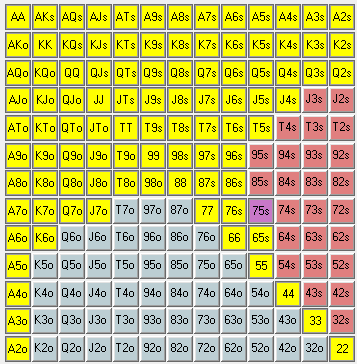
The minimum and maximum buy-in at a table is usually set in relation to the big blind. At live games, the minimum buy-in is usually between 20 and 50 big blinds, while the maximum buy-in is usually between 100 and 250 big blinds. Some online cardrooms offer 'short stack' tables where the maximum buy-in is 50 big blinds or less and/or 'deep stack' tables where the minimum buy-in is 100 big blinds or more.
Missed blinds[edit]
In cash games that do not deal cards to players who are absent from the table at the start of the hand (or, in online games, are designated as 'sitting out'), special rules are necessary to deal with players who miss their blinds.
In such a situation, if a player misses his or her big blind, he or she will not be dealt in again until the button has passed. At that point, if the player wishes to rejoin the game, he or she must 'super-post' - he or she must post both the big and small blinds in order to be dealt cards. Of these, only the big blind is considered 'live' while the small blind is 'dead' - it is placed in the center of the pot apart from the big blind and will not count towards calling any additional bets or raises by other players. If the player has only missed the small blind, then the same procedure applies except that the player only has to post the 'dead' small blind to rejoin the game. Most cardrooms allow players to relieve themselves of these obligations if they wait until they are again due to post the big blind before rejoining the game.
Some cardrooms hosting live cash games do not allow players to miss and/or avoid paying blinds in this manner. In these games, all players with chips on the table are dealt in whether or not they are present at the table. Any blinds due will be posted from the player's stack - depending on the cardroom's rules this will be done either by the dealer, another cardroom employee or a nearby player under staff supervision. Whenever a player has not returned to the table by the time it is his turn to act, his or her hand is automatically folded. Under such rules, if a player wishes to be absent from the table then the only way he or she can avoid paying blinds is to cash out and leave the game altogether.
Blinds in tournament play[edit]
In poker tournament play, blinds serve a dual purpose. In addition to the purpose explained above, blinds are also used to control how long the tournament will last. Before the tournament begins, the players will agree to a blinds structure, usually set by the tournament organizer. This structure defines how long each round is and how much the blinds increase per round. Typically, they are increased at a smooth rate of between 25% and 50% per round over the previous round. As the blinds increase, players need to increase their chip counts (or 'stacks') to stay in the game. The blinds will eventually consume all of a player's stack if he or she does not play to win more.
Unlike many cash games, it is not possible for a player to 'miss' blinds in a tournament. If a player is absent from the table, he will continue to have his or her cards dealt and mucked and will have blinds and, if applicable, antes taken from his stack as they are due, either until he or she returns or until his or her stack is completely consumed by blinds and antes. A player who loses his or her chips in this manner is said to have been 'blinded off.'
Goals[edit]
There are two main goals for the blinds structure:
- Ensure that by the time the desired duration of the tournament is reached, it will be very hard for players with small stacks to stay in the game. This forces players with smaller stacks to play them aggressively, thus increasing their chip count or losing everything quickly.
- Ensure that players, in general, do not have a large stack relative to the blind level.
Heads Up Poker Who Is The Small Blind
If desired, antes can be added to further increase the pressure to win more chips.
Example[edit]
If each player in a tournament starts with 5,000 in chips and after four hours, the big blind is 10,000 (with a small blind of 5,000), it will be very difficult for a player with only 15,000 in chips to stay in the game.