How Do You Roll Dice In Craps
Beginning gamblers often shy away from the craps table because the game looks complicated. It’s actually easy to play craps because the math keeps everyone honest. A rule of thumb to live by in any casino game is “the more they pay the less likely you are to win the bet”. Hence, there is no shame and a lot of wisdom in playing a conservative craps strategy. Here is a look at 12 secrets every craps player should learn to improve their game.
Unbalanced dice do not roll randomly. And casinos replace their dice often. Casino dice have machine-tooled straight edges. These edges eventually wear down, accumulating imperfections. Imperfections add bias to rolls. Casino dice are larger and straighter than board gaming dice because players must throw the dice so far on a craps table. The only way to beat craps is to know the 'Loop Hole' - enter Dice Control Well, you can't exactly control the dice. I like how the Dice Coach refers to it - Dice Influence. The 'Loop Hole' is the fact that the casino makes money from craps as long as the dice are perfectly random. This is how their mathematicians made their calculations.
If you establish a point on the come-out and if you then roll the point again before a 7 (which concludes the game), you keep the dice and continue rolling. However, if you establish a point on the come-out and if you then roll a 7 before the point (which concludes the game), you do not get to continue rolling the next game. Then place the dice square on the craps table and position them parallel to the back wall and facing it. Before you roll the dice, you should select an area located at a few inches before the back wall. Try to land the dice on that place. Do your best to hit the same place as often as possible. Look at how well the dice actually stop directly on the axis. This is hard to do and many people cannot do this. If you are having trouble getting to stop on the axis, then set the dice with sevens on all the faces that you can. If you do get your dice to stop on the axis often, then do the opposite and do not put as many sevens on the faces.
1. Why are Casino Dice Special?
Casinos use transparent dice because they hide no flaws. Opaque dice can be manufactured to varying standards and can hide balancing flaws. Unbalanced dice do not roll randomly.
And casinos replace their dice often. Casino dice have machine-tooled straight edges. These edges eventually wear down, accumulating imperfections. Imperfections add bias to rolls.
Casino dice are larger and straighter than board gaming dice because players must throw the dice so far on a craps table. The felt top and lining help the dice bounce more randomly than a smooth table top does.
So while you may be practicing your die throws at home, you’re not going to get the same action as at a casino, especially if you never replace your practice dice.
2. How the 5-Count System Works
Since 1994 craps players have debated whether the Captain’s 5-Count system is legit. This system tells you when to bet on a shooter other than yourself. Here are the 5 counts:
- Any point on the Come Out roll roll.
- Any good roll after the 1st Count roll.
- Any good roll after the 2nd Count roll.
- Any good roll after the 3rd Count roll.
- The first point rolled after the 4th Count roll.
You begin placing low bets on the shooter after he hits his 5th Count roll. If he never gets there then you never bet on that shooter. Never bet big on another shooter.
The 5-Count method reduces the number and size of bets you place on other shooters, thus reducing your overall risk. The downside of using the 5-Count method is that you watch more than play, but betting on a drunk guy to throw dice the way you want is a pretty risky bet.
3. You Can Stop the Game for a Dispute
Sometimes the dice roll funny, or maybe you’re not sure you were paid correctly. Before the dice are thrown again, if you are certain something is wrong, you can stop the game. You can ask the dealers to recount or reconsider or, if you disagree with their decisions, ask to speak to the pit boss. This is an option of last resort when you are sure you are right. Casinos want to keep the table in play and will work to resolve disputes quickly but they’ll also ask troublesome or argumentative players to leave.
Stopping play is a mix of courtesy, privilege, and right. It’s not a gambling strategy, at least not a winning one.
4. The More Bets You Place the Worse Your Chances of Winning
This is true in any table game, but some craps players love to place multiple bets. You’re taking on more risk, not spreading the risk, when you place several bets at the same time.
5. Know the Die Roll Probabilities
In a completely random game the chances of any given number on either die being rolled is 1 in 6. The chance of rolling any combination of numbers on the dice is 1 in 36. This “1 in 36” number can mislead you. There are only 11 possible values (2 through 12) that you can roll.
“7” is the most frequent die roll combination. There are 6 ways to roll a “7”. Some writers say there are three ways to roll a “7”: 1 and 6, 2 and 5, or 3 and 4. However, the math has to account for each die separately; hence, the probability of rolling a “7” in craps is 1 in 6.
In declining order of probability, the possible combinations in craps are:
- 7 (1 in 6)
- 6 or 8 (5 in 36)
- 5 or 9 (4 in 36)
- 4 or 10 (3 in 36)
- 3 or 11 (2 in 36)
- 2 or 12 (1 in 36)
6. The “Pass” Bet is More Likely to Pay on Come Out than the “Don’t Pass” Bet
Both Pass and Don’t Pass pay even money so you can bet either way. Still, when you look at the probability table above, the shooter has 8 chances in 36 of rolling 7 or 11 on the Come Out roll and 3 chances in 36 of rolling a 2 or 3. If you are just hoping to win on the Come Out roll, go with the “Pass” bet.
7. The 6 and 8 Points Pay the Most over Time
The 6:5 odds for the 6 and 8 points are the worst and the 2:1 odds for the 4 and 10 points are the best. But the probabilities are best for the 6 and 8 and worst for the 4 and 10.
The premium on a 6:5 payoff for 6 or 8 is 20% over your bet. The premium on a 3:2 payoff for a 5 or 9 is 50% of your bet. The premium on a 2:1 payoff for a 4 or 10 is 100% of your bet. In a perfect distribution of 36 die rolls your expected total premiums are:
- 5 * 20% = 100% (betting on 6 or 8)
- 4 * 50% = 200% (betting on 5 or 9)
- 3 * 100% = 300% (betting on 4 or 10)
Although the 300% ROI for 4/10 looks great there is a slight edge for 6/8 bettors. Because you are losing all those other bets, you lose the least amount of money with the 6/8 points. Note also that multiplying (bets + premiums) by expected wins across the board results in a 600% return. The distribution with the fewest losses is the way to bet.
8. The More Complicated Your Strategy the More Risk You Take
The more you have to think about where your money goes, the odds and probabilities, and when you can bet, the more likely you will make a mistake. High risk strategies pay off less often than low risk strategies. Most experts agree that the long, slow game works best in craps, especially for non-expert players. Keep your money on the Pass Line until you’re way ahead.
9. Avoid Hedge Bets
Ignore dealer calls for “any craps” bets. Your expected return declines your risk grows when you hedge bets. “Any craps” betting is a bet on a bet. This just adds conditions to your Pass Line bet. The strategic way to gamble is to minimize risk while maximizing potential return on bet. The house will drain your bankroll any way it can and hedge bets are a favored gimmick.
10. Use the Tower of Hanoi Method to Manage Your Betting
The Tower of Hanoi is a math puzzle about moving stacks of disks among three pegs. You can never place a disk on a smaller disk. The Tower of Hanoi rule assumes you are willing to lose everything in your bankroll. To conserve your money and manage risk, begin by making minimum bets. Increase your bets only when your bankroll is above its starting value.
Many craps players only risk 5% of their stakes on any bet. The 5% method works well enough but you’ll eventually run into the table minimum. The Tower of Hanoi method starts with the minimum bet as a floor, not 5%. As long as your bankroll is growing you can increase your bets toward the table maximum.
11. Never Return to Your Starting Stake
Let’s say your betting strategies have paid off enough that you have doubled your money. Once you reach that goal you should set a new floor. Walk away from the table if your stake drops to 150% of your original bankroll. This way you walk away a winner.
But there is another reason to do this. If you play any game too long you become tired, especially if you have been drinking. Your decision-making suffers when you are tired. Take “winner’s breaks” as often as possible so that you can give your brain a chance to rest.
12. The House Edge is not Determined by the Odds
Some gamblers assume the house loses more money on the basis of the odds on a given bet. It doesn’t work that way. The game is designed to pay about the same over time on any basic bet but to dilute your return with extra bets. In other words, the house edge is determined by the math behind the game. The odds are just what they are willing to pay you to maintain that edge over time.
Conclusion
Craps is a fine game for any gambler who enjoys taking risks, but you do need to understand the game. Fortunately, craps is designed for players of all experience levels. You don’t have to play all the different types of bets. And isn’t it interesting that the best strategies favor beginner-level bets anyway?
Please enable JavaScript to view the comments powered by Disqus.I’ve written previous posts in this series about craps — that examined the staff at the craps table and the equipment used to play (the dice and the table). This post is the 1st one in which I discuss the nuts and bolts of how to play a craps game in a casino.
Part 3 of 6
- 1 The Craps Dealers and Other Staff at the Dice Table: Who’s Who
- 2 How the Craps Table Layout Works and How the Dice Work
- 4 The Best and Worst Craps Bets You Can Make
- 5 Craps Bets Ranked According to House Edge
- 6 How (and Why) to Act Like a Craps Player
I’ve seen other pages that explain how to play craps, and some of them are very good indeed. I hope, though, that this post will include a level of detail heretofore unseen on the internet as it relates to how to play craps.
First Things First
You walk up to a craps table that’s just opened for action. A few other players join you. Maybe a class on how to play craps just finished—casinos usually hold those earlier in the day and then open up a table immediately afterward.
You and your new companions will start by buying in. You’ll put cash on the table and get chips in exchange. Once everyone has bought in, the stickman will give the dice to the player on his left. Dice is like cards, by the way.
If you don’t go broke 1st, you’ll get a chance to roll the dice, too. Don’t worry about that. You just have to wait your turn.
Also, you and the other players aren’t required to roll the dice. You can always pass on that, for any reason you want to. No one will give you a hard time about it, either.
The player gets to choose 2 dice from the 6 or 8 dice he’s given. Once she picks those dice up, the stickman puts the other dice away until there’s a new shooter. (They go in a dice tray.)
But the game still can’t start, because no one has placed a bet yet. Actually, though, at a real craps table, bets will have been made already. I just haven’t mentioned that yet.
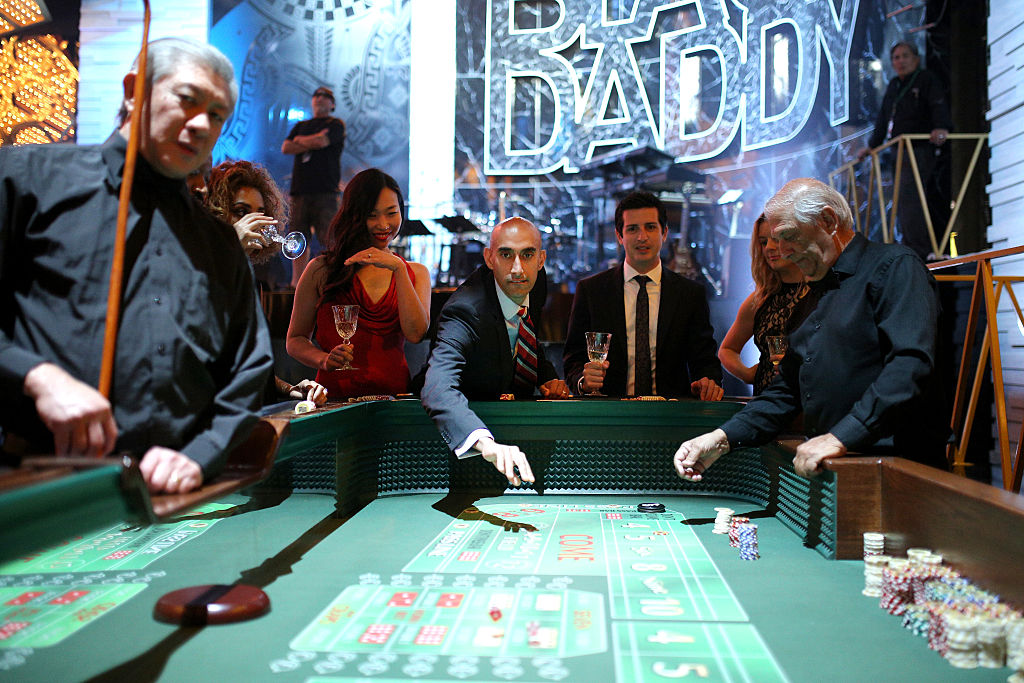
Usually, players will start by making pass bets and don’t pass bets. You’ll see a lot more pass bets than don’t pass bets, too.
In this case, “pass” means for the dice to win. “Don’t pass” means for the dice to lose.
If you read my previous post about the table layout, you’ll already know where those bets go on the table. In fact, those are bets you can place on the table yourself, as opposed to some of the bets where the dealers have to place the bet on your behalf.
But you’re not limited to just those 2 options. You can bet on the field. You can bet on big 6. You can bet on big 8. You can even place a proposition bet in the center of the table.
One Roll Bets
It seems appropriate at this point in the discussion to point out the different kinds of bets available. Bets like pass and don’t pass are multiple roll bets. They stay in action as the dice are rolled repeatedly until they’re resolved.
The proposition bets, and some of the other bets, like the field bet, are one roll bets. These are bets made on the outcome of the very next roll. They win or lose based on what happens on that roll. They don’t stay on the table.
The Come Out Roll Is When the Action Starts
The 1st roll a new shooter makes is called “the come out roll.” If she rolls a 7 or an 11 on the come out roll, the dice win. Anyone who placed a bet on the pass line gets paid off at even money. Anyone who bet on don’t pass loses their bet, and their money gets collected.
But if the shooter rolls a 2, 3, or 12 on the come out roll, the pass line bet is an immediate loser. This is called “crapping out.” Those totals—2, 3, and 12—are “craps.” The don’t pass line, though, MIGHT be a winner.
Remember when I discussed the layout and how the don’t pass bet includes the words “bar 12” or “bar 2?”
This means that if the shooter rolls a 12 (or a 2, depending on what the layout says), the don’t pass bet doesn’t win any money. Instead, it’s treated as a “push” or a “tie.” You get your money back, but you don’t get any winnings with it.
Any other total sets a point. The possible points are 4, 5, 6, 8, 9, or 10.
If the shooter doesn’t set a point, she gets to keep the dice and continue to roll. It doesn’t matter if the dice won or lost on the come out roll. And any time the shooter hasn’t set a point, the next roll is always a new come out roll.
But if a point number has been rolled, the shooter keeps rolling until she either:
- Rolls the point number again. (In which case, the dice win.)
- Rolls a 7. (In which case, the dice lose.)
If the dice win, the shooter keeps the dice and continues to shoot. Also, the pass line bets pay off at even money.
If the dice lose, the next person to the left of the shooter gets a turn as shooter. Also, the don’t pass bets pay off at even money.
After this action is completed, there’s a new come out roll, regardless of whether or not there’s a new shooter.
That’s the basics of craps right there—the come out roll and whether the dice win or lose. Sometimes they win or lose on the first roll; sometimes there are subsequent throws which determine whether they win or lose.
But the other bets are whether the casino really cleans up.
Summarizing the Action
It helps to think of craps as being a game played in rounds. Each round starts with a come out roll.
The dice can win or lose immediately on the come out roll. If you roll a 7 or an 11, that’s an immediate win. If you roll a 2, 3, or 12, that’s an immediate loss.
Any other number sets a point. In that case, the shooter continues rolling the dice until she either rolls a 7 or the point again. If she rolls a 7 before rolling the point, the dice lose. If she rolls the point before rolling the 7, the dice win.
The pass bet pays off at even money when the dice win.
The don’t pass bet pays off even money (or pushes) when the dice lose. The only time it’s a push is when a 12 is rolled on the come out roll. (Or if a 2 is roller in a casino that says “Bar 2” instead of “Bar 12.”)
And that’s it.
Craps is a much simpler game than you expected, isn’t it?
The real wrinkles start when you look at the dizzying arrays of bets that are available to be made in the game besides the pass and don’t pass bets.
How Do You Roll Dice In Craps Game
I’ll look at the available bets in the next post.
Conclusion
A craps game starts when players buy in, place bets, a shooter is chosen, and then that shooter rolls the dice. The most basics bets in the game (the pass and don’t pass bets) pay off based on whether the dice win or lose, respectively.
You do, of course, have multiple other bets available on the table. Some of them are one roll bets, like proposition bets, while others are determined after multiple rolls.
How Do You Roll Dice In Craps Machines
This is the 3rd post in my series about playing craps. My next post will include details about how the other bets on the craps table work.